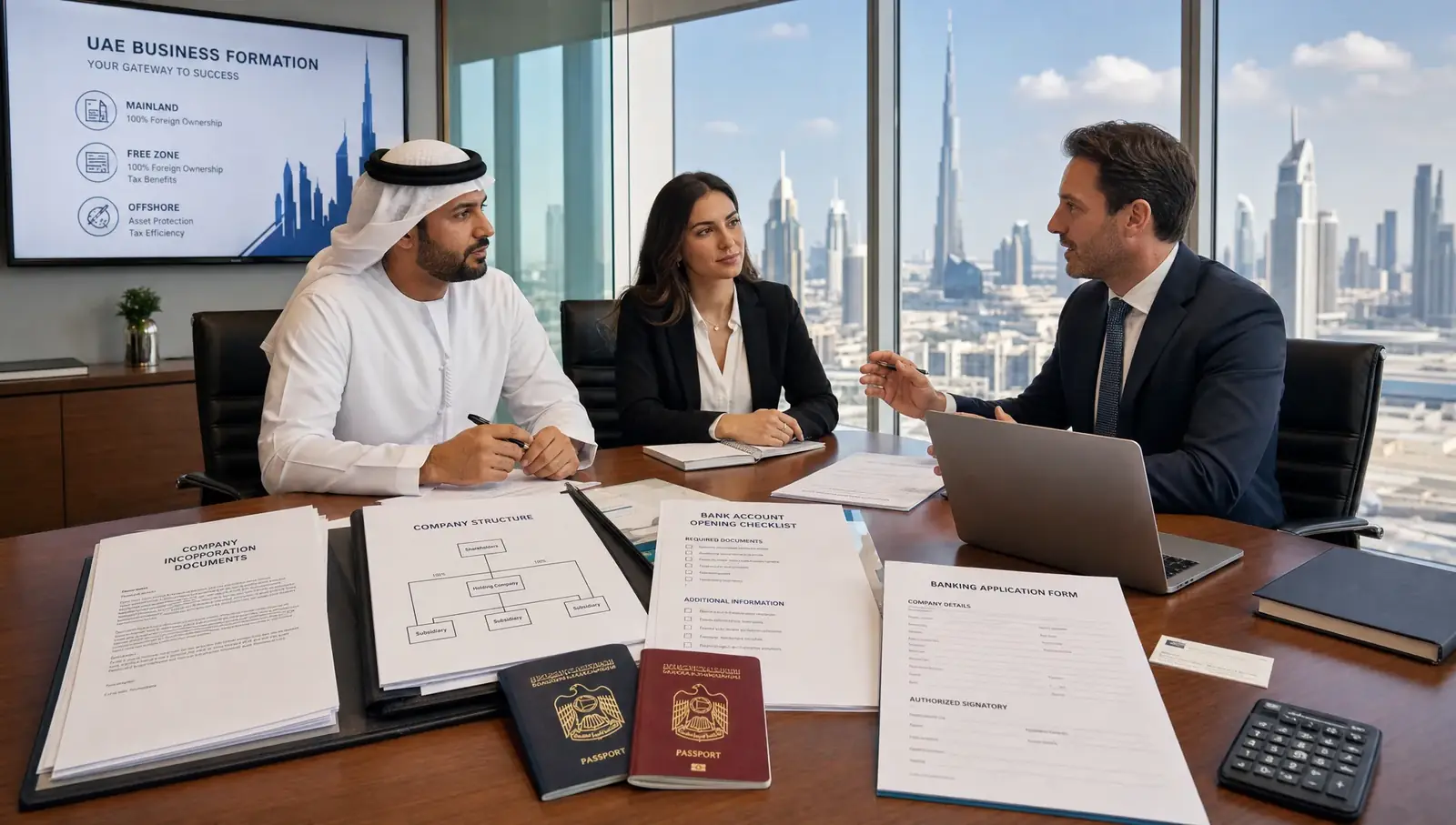
Company formation in the UAE means choosing between four genuinely different categories of entity, each with its own legal forms, regulator and rules on ownership, activity and substance. This guide sets out the requirements, the process and where founders most often choose the wrong structure.
Company formation in the UAE means registering a business entity under one of four distinct categories: onshore (mainland), a commercial free zone, an offshore jurisdiction, or one of the two financial free zones, DIFC or ADGM. A company already incorporated in one of those categories does not always need to start over: our guide to redomiciliation covers moving an existing entity into the DIFC or ADGM without rebuilding it. Each category has its own registering authority, its own set of legal forms, and its own rules on ownership, activity, premises and regulation. There is no single "UAE company"; there is a decision about which of these four frameworks fits the business.
Most guides to this topic collapse straight into "mainland versus free zone" and stop there. That misses two categories that matter a great deal to international investors and family offices: offshore vehicles, which exist purely to hold assets, and DIFC/ADGM, common law financial centres that operate outside the general free zone system entirely.
This guide sets out what company formation actually requires across all four categories: the legal forms available, the documentation authorities expect, how the process runs, and what happens once the licence is in hand.
The four categories of UAE company formation
| Onshore (mainland) | Commercial free zone | Offshore | DIFC / ADGM | |
|---|---|---|---|---|
| Registering authority | Emirate's Department of Economic Development | The relevant free zone authority | RAK ICC, JAFZA Offshore, Ajman Offshore | DIFC Registrar of Companies; ADGM Registration Authority |
| Can trade within the UAE | Yes, without restriction | Generally within the zone and internationally; onshore trading is restricted | No | Within the centre and internationally; onshore UAE trading is restricted |
| Can sponsor UAE residence visas | Yes | Yes, subject to premises | No | Yes |
| Needs UAE office premises | Yes | Yes, though flexi-desk options exist in many zones | No, administered through a registered agent | Yes |
| Legal framework | UAE federal and emirate law | UAE federal law plus zone regulations | UAE federal law plus offshore regulations | Independent common law framework with its own courts |
| Financial services regulator | Sector regulators where relevant | Generally none | None | DFSA (DIFC); FSRA (ADGM) |
| Typical use | Businesses trading with the UAE market or government | International trading, services, technology, media, logistics | Holding shares, property or other assets outside the UAE | Financial services, funds, holding companies, SPVs, foundations, family offices |
Choosing between these is the single decision that determines almost everything that follows: which authority you deal with, what activities you can list, whether you can sponsor visas, and how a bank or institutional counterparty will read the structure.
Legal forms available
The UAE Ministry of Economy and Tourism recognises nine mainland legal forms, spanning sole establishments, limited liability companies, civil companies, branches and representative offices of foreign companies, and several categories of joint stock company. In practice, most operating businesses use one of a handful:
- Limited liability company (LLC): the standard mainland operating company, available with one or more shareholders
- Free zone establishment (FZE) or free zone company (FZCO / FZ LLC): the free zone equivalents, distinguished mainly by shareholder number
- Branch of a foreign company: not a separate legal entity; the foreign parent remains fully liable, and no new shareholding is created
- Civil company: used for certain professional partnerships, such as legal, medical and accounting practices
- International business company (IBC): the offshore vehicle used by RAK ICC and similar registries, mainly for holding assets rather than trading
- Private company limited by shares: the standard DIFC and ADGM form for operating and holding companies, alongside special purpose vehicles and foundations for asset-holding and succession structures
For a single founder running a straightforward trading or services business, the choice of legal form is usually simple. It becomes a genuine decision once there are multiple or corporate shareholders, investors who expect a familiar governance framework, or assets that should sit apart from trading risk.
Requirements and documentation
Documentation requirements vary by category and by whether shareholders are individuals or companies, but the core file looks similar across most routes:
- For individual shareholders and directors: passport copies, proof of residential address, and in some cases a CV or professional background summary
- For corporate shareholders: certificate of incorporation, constitutional documents, a register of directors and shareholders, and a board resolution approving the investment, typically notarised and legalised in the home jurisdiction before submission
- For the new entity: a memorandum of association or equivalent constitutional documents, and a description of the proposed business activity, since UAE licensing is activity-based and the activity drives which authority, approvals and legal form apply
- Premises or a registered agent: onshore and free zone companies need evidence of premises, from a full office lease to a flexi-desk package; offshore companies instead appoint a licensed registered agent and hold no UAE premises at all
- For regulated activity in DIFC or ADGM: a business plan, ownership and controller disclosures, and details of key individuals, submitted to the DFSA or FSRA as part of authorisation rather than a standard registration filing
Some activities carry additional requirements before a licence can be issued. Healthcare, education, legal services, food-related businesses and other regulated sectors typically need a specific approval from the relevant ministry or sector authority in addition to the standard incorporation file.
How the process works
- Define the activity. UAE licensing runs on defined activity lists. The Ministry of Economy references more than 2,000 recognised economic activities across six licence categories (commercial, professional, industrial, tourism, occupational and agricultural). The activity chosen determines the available legal forms, whether external approvals apply, and, in DIFC or ADGM, whether the business is treated as regulated financial services.
- Choose the category and registering authority. Onshore companies register with the Department of Economic Development in the relevant emirate; free zone companies register with the chosen zone authority; offshore companies register through a licensed registered agent with RAK ICC or an equivalent registry; DIFC and ADGM companies register with their own Registrar, with regulated activity going through the DFSA or FSRA first.
- Reserve the trade name and secure initial approval. The proposed name must meet UAE naming conventions and not conflict with existing registrations. Initial approval confirms the authority has no objection to the proposed shareholders and activity proceeding.
- Prepare and submit documentation. The shareholder, director and constitutional documents above are compiled, along with any external ministry or regulator approvals the activity requires.
- Arrange premises or a registered agent, as the category requires, and finalise the constitutional documents, the memorandum of association or equivalent.
- Pay the applicable fees and collect the licence. Some mainland activities can be registered within days through the UAE's instant licensing initiatives, such as the Basher platform referenced by the Ministry of Economy; others, particularly those needing external approvals or a substantive regulatory review, take considerably longer.
- Register with the Chamber of Commerce, where the relevant authority requires it, completing the formal registration record for the entity.
Founders comparing timelines across articles should treat any single figure with scepticism. The Ministry of Economy's own materials describe both a fifteen-minute digital route for straightforward activities and a multi-day Department of Economic Development process for others, and that is before regulated DIFC or ADGM licensing, which is measured in months rather than days.
What happens after the licence is issued
The licence establishes the company; it does not make it operational or compliant. Immediately afterwards, most newly formed UAE companies need to:
- Register for UAE corporate tax with the Federal Tax Authority and begin annual filing obligations. Free zone companies can qualify for preferential treatment on certain qualifying income, but only where ongoing conditions, including adequate substance, continue to be met. This is an analysis specific to the facts, not an automatic outcome.
- Register for VAT, where the activity and turnover require it.
- Maintain statutory registers, including ultimate beneficial ownership records, and keep the resolutions and filings that authorities and banks will later ask to see.
- Keep proper accounting records from incorporation, with audit requirements depending on jurisdiction and legal form.
- Arrange visas and Emirates ID, where the entity will sponsor employees or shareholders, subject to premises-linked visa quotas.
- Open a corporate bank account, which runs on the bank's own know-your-customer timeline rather than the authority's. Our UAE corporate banking guide covers what banks typically review.
Advantages and limitations by category
Onshore (mainland). Unrestricted access to the UAE market, including government contracts, at the cost of a heavier documentation and approval process for some activities.
Commercial free zones. Fast, well-established administration and full foreign ownership, but activity is generally restricted to within the zone and international trade, so onshore UAE trading requires additional arrangements.
Offshore. Simple, low-administration holding structures with no premises requirement, but no ability to trade in the UAE, sponsor visas or lease commercial space, a genuine limitation that catches founders who assume "offshore" is simply a cheaper free zone.
DIFC / ADGM. Common law governance, an independent judiciary, and purpose-built vehicles for funds, holding structures and family offices, recognised by banks and institutional counterparties, but with a substantive regulatory review for financial activity and a framework that is unnecessary overhead for an ordinary trading business.
Common mistakes in UAE company formation
- Treating offshore as a cheap free zone. Offshore companies cannot trade in the UAE or sponsor visas; using one for an operating business rather than an asset-holding structure creates problems that surface later, usually at the bank.
- Choosing a free zone before confirming where customers actually sit. A zone licence that cannot support onshore UAE trading is the wrong choice for a business that mainly serves local customers.
- Assuming the old mainland ownership rules still apply. Guides describing a mandatory majority Emirati shareholder are describing the pre-reform position; most activities now permit full foreign ownership on the mainland.
- Putting a holding structure into a commercial free zone or mainland entity because it was administratively simpler, rather than into DIFC, ADGM or an offshore vehicle built for that purpose.
- Assuming a licence means zero tax. Corporate tax registration is generally required regardless of category, and free zone preferential treatment is conditional, not automatic.
- Leaving banking until after incorporation, without first checking whether the intended structure and ownership chain are explainable to a bank's compliance team.
- No plan for the obligations that start after incorporation: registers, filings, renewals and tax returns arrive whether or not anyone budgeted the time to handle them.
Which category suits which business
- A business trading with UAE customers or government entities: onshore, licensed by the relevant Department of Economic Development
- A consultancy, trading or services business serving international clients: a commercial free zone
- A structure that only needs to hold shares, property or other assets outside the UAE, with minimal administration: an offshore vehicle such as RAK ICC
- A fund manager, investment firm, holding company or family office: DIFC or ADGM, where common law vehicles, foundations and prescribed companies exist for exactly this purpose; our guide to DIFC licence types sets out the options in that centre
- A UK or European business relocating or adding a UAE presence: the right category depends on activity and ownership; our guide to setting up a business in Dubai walks through the process end to end for that specific route
If more than one category could plausibly fit, that is usually a sign the structure deserves proper advice before an application goes in, since moving an entity between categories later is more disruptive than choosing correctly the first time.
How Atlas Corporate Services can help
Atlas advises founders, international investors, fund managers and family offices on which UAE category and legal form actually fits their structure, before any application is filed. That includes DIFC company setup and ADGM structures for regulated and holding activity, company secretarial and governance support once the entity exists, compliance and economic substance work to keep it in good standing, and residency and banking coordination for the steps that follow incorporation.
If you are weighing up onshore, free zone, offshore or DIFC/ADGM formation, or evaluating who should carry out the work, speak with the Atlas team before you commit to a structure. Our guide to choosing business formation services in the UAE covers how to evaluate advisers if you are still selecting one.
This guide covers the UAE as a whole. If you have already settled on Dubai, our overview of business setup in Dubai is the better starting point.
This article is general information and does not constitute legal, tax or regulatory advice. UAE rules and authority requirements change; confirm the current position with a qualified adviser for your specific case.
Frequently Asked Questions
What is company formation in the UAE?
Company formation in the UAE is the process of legally establishing a business entity under one of the country's licensing frameworks: onshore (mainland), a commercial free zone, an offshore jurisdiction, or one of the two financial free zones, DIFC or ADGM. Each route has its own registering authority, legal forms, documentation and rules on ownership, activity and where the company can operate.
How many types of company formation are there in the UAE?
Four categories, not two. Onshore mainland companies are licensed by the Department of Economic Development in the relevant emirate and can trade anywhere in the UAE. Commercial free zone companies are licensed by the individual zone authority and suit international trading and services. Offshore companies, such as RAK ICC or JAFZA Offshore, are holding and asset-holding vehicles that cannot trade within the UAE or sponsor visas. DIFC and ADGM are common law financial centres with their own courts, built for financial services, funds, holding structures and family offices.
What legal forms can a UAE company take?
The UAE Ministry of Economy and Tourism lists nine mainland legal forms, including sole establishments, limited liability companies, civil companies, branches and representative offices of foreign companies, and several joint stock company structures. Free zones typically offer their own variants, most commonly a free zone establishment (FZE) with a single shareholder or a free zone company (FZCO/FZ LLC) with multiple shareholders. DIFC and ADGM principally use the private company limited by shares, alongside special purpose vehicles and foundations for holding and succession purposes.
What documents are required for UAE company formation?
Individual shareholders and directors typically need passport copies and proof of residential address. Corporate shareholders need a certificate of incorporation, constitutional documents, a register of directors and shareholders, and a board resolution approving the investment, usually notarised and legalised in the home jurisdiction. Every application also needs a description of the proposed activity, the constitutional documents for the new entity, and evidence of premises or a registered agent, depending on the category chosen.
Do I need a local sponsor to form a company in the UAE?
Not for most activities. Free zone, offshore and DIFC/ADGM companies have always permitted full foreign ownership. Following the amendment to the UAE Commercial Companies Law, mainland companies can also be 100% foreign owned for the majority of commercial and industrial activities. A limited list of activities considered to have strategic impact still carries different ownership rules, so this should be confirmed for your specific activity rather than assumed.
How long does UAE company formation take?
It depends entirely on the route. Some mainland activities can be registered within days through instant licensing initiatives, while others involving external ministry approvals take longer. Free zone incorporation with complete documents is often measured in days to a couple of weeks. Offshore incorporation is typically quick because there is no office or visa quota to arrange. Regulated DIFC or ADGM licences take considerably longer, generally months, because the regulator conducts a substantive review of the business plan, controllers and key individuals. Banking due diligence runs on its own timeline after the licence is issued.
What is the difference between a free zone company and an offshore company?
A free zone company can lease premises, sponsor employee visas and, within the rules of its licence, conduct business internationally and with other free zone or mainland entities. An offshore company, such as a RAK ICC or JAFZA Offshore entity, cannot rent commercial premises, cannot sponsor visas and cannot conduct business inside the UAE. Offshore vehicles exist mainly to hold shares, property or other assets outside the UAE and are administered through a registered agent rather than a physical office.
Is UAE company formation suitable for a holding company or family office structure?
It depends on which category is used. A commercial free zone or mainland entity is generally not the right home for a holding company, SPV or family office, because these structures are built for trading activity rather than asset holding, governance and succession planning. DIFC and ADGM offer purpose-built vehicles, including foundations, prescribed companies and special purpose companies, that are widely recognised by banks and institutional counterparties for exactly this use.
What happens after the UAE company licence is issued?
Incorporation is the start, not the finish. Newly formed companies generally need to register for UAE corporate tax with the Federal Tax Authority, register for VAT if the activity and turnover require it, maintain statutory registers including ultimate beneficial ownership records, keep proper accounting records, and, for free zone companies relying on preferential tax treatment, meet ongoing economic substance conditions. Visas, Emirates ID and a corporate bank account typically follow the licence rather than accompany it.